
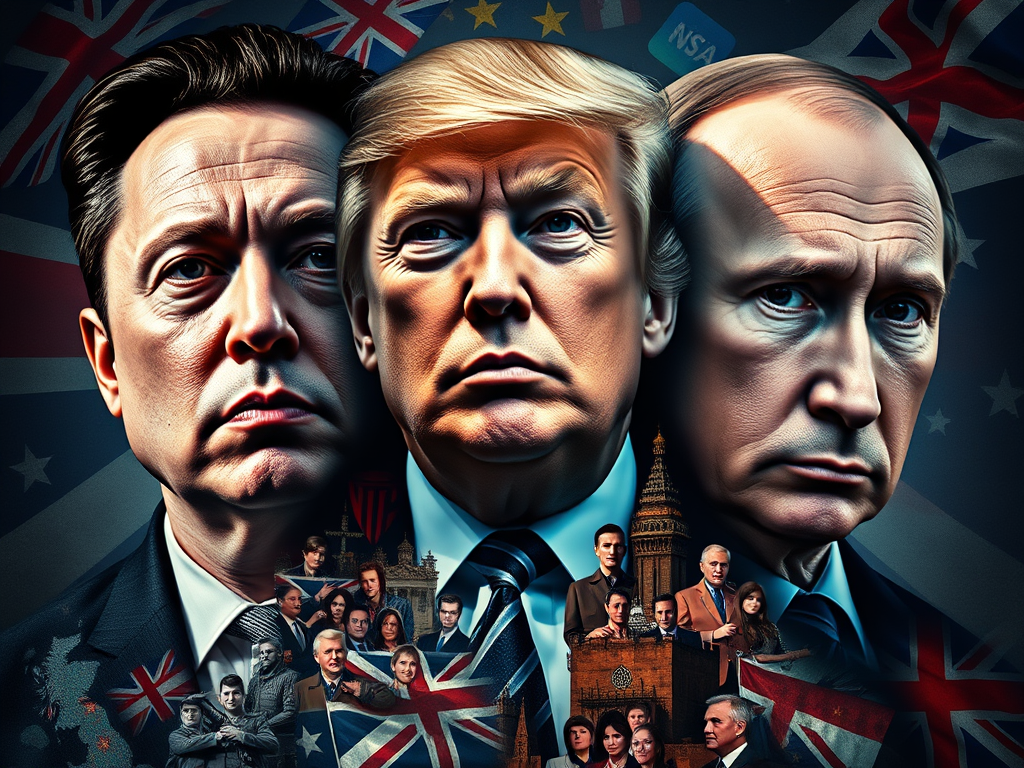
The interplay of global power is shifting in dramatic ways, and the United Kingdom finds itself caught in a complex web of influence. With Elon Musk reportedly taking a keen interest in UK politics, and his connections to Donald Trump and the latter’s amicable relationship with Vladimir Putin, a worrying narrative begins to unfold. Let’s examine how this dynamic could impact the UK, particularly in its post-Brexit state.
Elon Musk: The Power of Influence
Elon Musk, the billionaire entrepreneur behind Tesla, SpaceX, and X (formerly Twitter), wields extraordinary power, both financial and digital. His involvement in the 2024 U.S. presidential election—as one of Donald Trump’s largest financial backers—demonstrates how Musk can influence political outcomes through a combination of wealth and control over information.
In the UK, Musk has been using X to engage with sensitive topics, particularly those that stoke division. Whether intentional or not, these tweets have the potential to amplify societal tensions. Given the platform’s global reach and Musk’s 100 million+ followers, his words carry weight, shaping public discourse and political narratives.
Social media platforms like X have been accused of fostering polarisation, and Musk’s ownership adds another layer of complexity. If his content strategy exacerbates divisions in the UK, it could destabilise an already fragile economy and society.
The UK’s Economic Vulnerabilities
The UK’s post-Brexit landscape makes it particularly susceptible to external influence:
- Service-Based Economy: With limited manufacturing and heavy reliance on sectors like finance and professional services, the UK’s economy is vulnerable to competition and market shifts.
- Isolation from Europe: Brexit has reduced the UK’s bargaining power by severing ties with the European single market, leaving it more dependent on bilateral deals.
- Economic Struggles: Rising inflation, stagnant growth, and a cost of living crisis have created significant challenges, making the country an easier target for external actors seeking to exploit its weaknesses.
Musk’s interest in the UK may coincide with efforts to bring more American corporations into the British market. By leveraging economic instability, these companies could dominate key sectors, extracting profits while further weakening the UK’s self-reliance.
The Trump-Putin Connection
Donald Trump, a close ally of Musk, has long maintained a controversial relationship with Vladimir Putin. If Trump and Putin share mutual strategic interests, weakening the UK could serve both their agendas. Here’s how:
- Reduced Support for Ukraine: The UK has been a staunch supporter of Ukraine in its fight against Russian aggression. A destabilised UK would struggle to provide the same level of aid, politically or financially, potentially tipping the balance in Russia’s favour.
- Fracturing Western Unity: The UK’s instability could create divisions within NATO and weaken alliances critical to countering Russian ambitions in Eastern Europe.
- Shifting Global Power: Both Trump and Putin could benefit from a fragmented Europe, with a destabilised UK as the linchpin of a broader strategy to diminish Western influence globally.
Historical Parallels: Divide and Rule
The tactics at play echo historical strategies of “divide and rule,” employed by empires to weaken opposition and maintain dominance. From the Romans to the Mughals, rulers have exploited societal divisions to consolidate power. In the modern context, social media and economic leverage have replaced armies, but the principles remain the same.
A divided UK would face heightened internal conflict, increased crime rates, and economic decline, creating fertile ground for external powers to intervene. Whether this intervention comes in the form of investment, political deals, or strategic alliances, the ultimate goal would be control and influence over British policy and markets.
The Bigger Picture
The implications of Musk’s involvement in UK politics, combined with the Trump-Putin dynamic, could have far-reaching consequences. With Musk’s ability to shape narratives, Trump’s potential influence as a U.S. president, and Putin’s ambitions in Eastern Europe, the UK faces challenges that extend far beyond its borders.
The question remains: how will these forces shape the future of the UK? And what can be learnt from history to navigate this intricate geopolitical landscape?




 Life in Full HD
Leave a comment